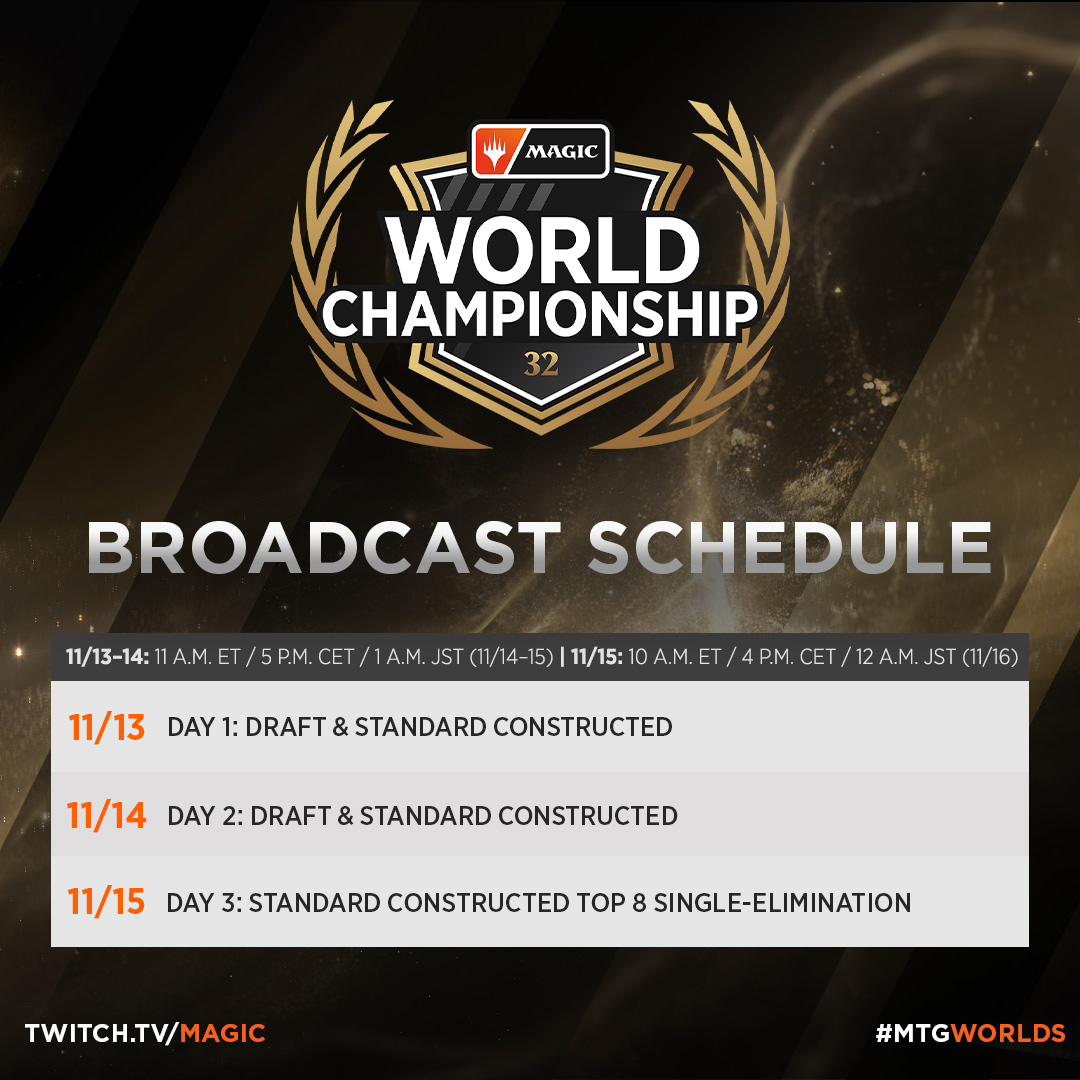
The decklists are in, the numbers are crunched, and Magic World Championship 32 begins tomorrow! From November 13–15 at MagicCon: Atlanta, 128 of the world's best Magic players will compete for a share of the $1,000,000 prize pool. The champion takes home $100,000, the Black Lotus-themed trophy, and the chance to work with the Magic design team on a future card bearing their likeness.
The competitors earned their seats over a long season: as Regional Champions, as winners on MTG Arena and Magic Online, through match points across the Pro Tours, or through a Top 8 finish at last year's World Championship, like reigning champion Seth Manfield. On Friday and Saturday, players will open with three rounds of Magic: The Gathering® | Star Trek™ Draft before switching to four rounds of Standard. After fourteen rounds across Friday and Saturday, the Top 8 will battle on Sunday in best-of-five Standard playoff matches.
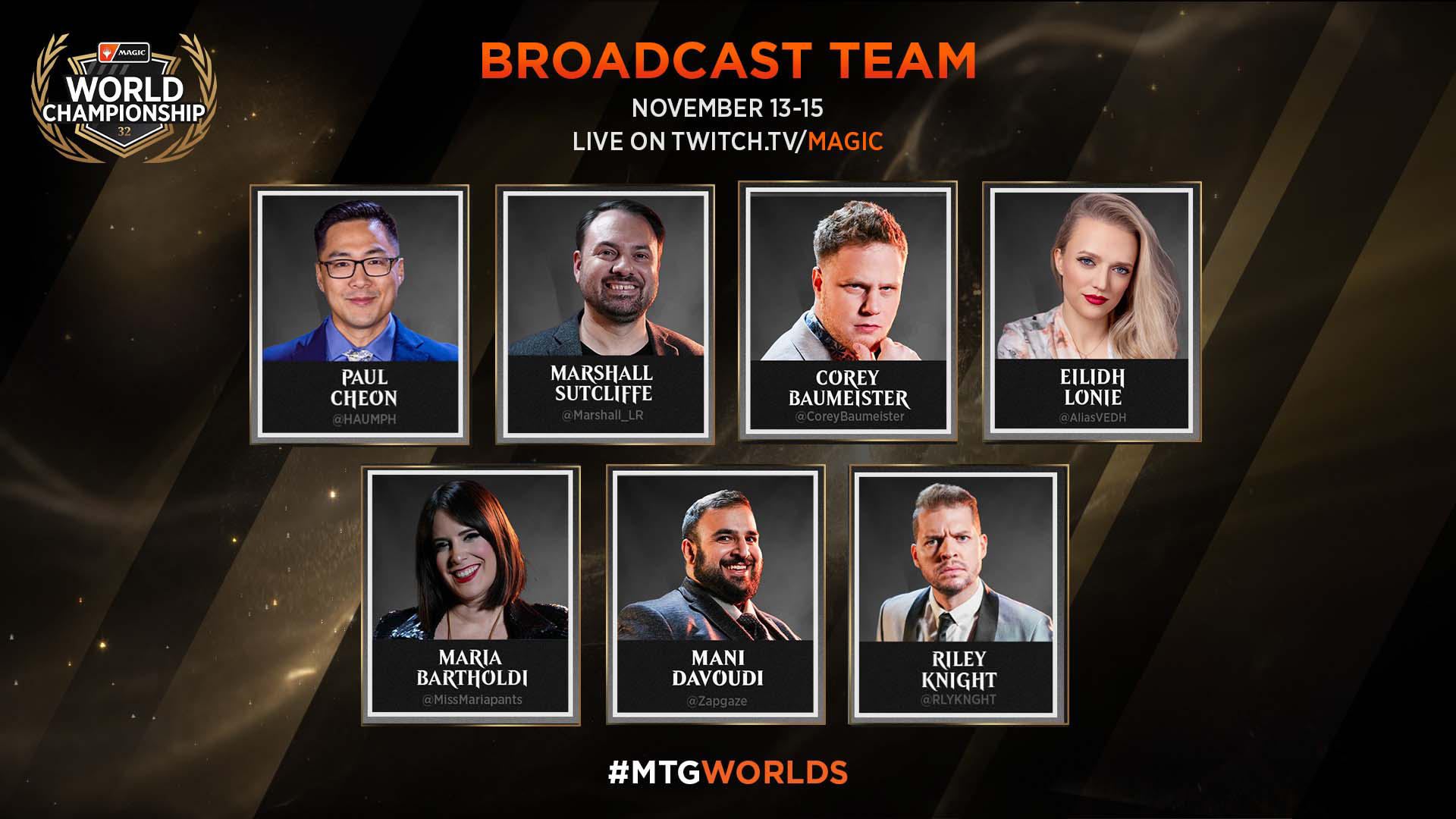
Coverage begins at 11 a.m. ET on Friday and Saturday and at 10 a.m. ET on Sunday, streaming live on twitch.tv/magic and the Play MTG YouTube channel. For the full schedule, player storylines, and everything else you need to know, check out the viewer's guide.
Standard Metagame Breakdown
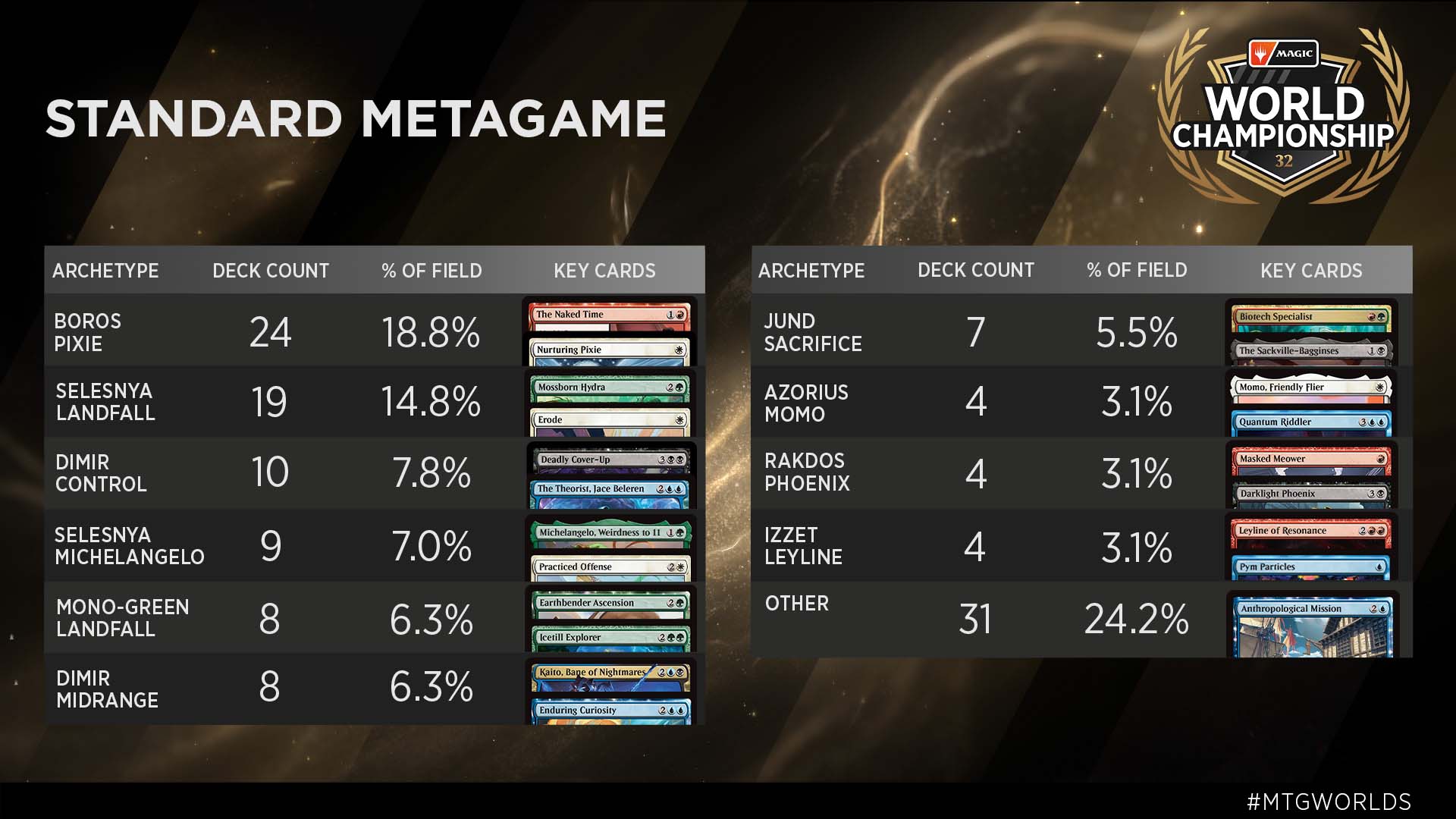
Standard, Magic's rotating 60-card format, currently encompasses expansion sets from Wilds of Eldraine onward, adding up to 20 sets. Since Pro Tour Secrets of Strixhaven in May, four new sets have joined the format, bringing over 1,000 cards with them. August's banning of Badgermole Cub, Gran-Gran, and Stormchaser's Talent shook up the established order, and Magic: The Gathering | Star Trek added one final wrinkle. With decklists due just one day after the set launched on MTG Arena, competitors had precious little time to test the newest cards. Against that backdrop, the Standard decks for Magic World Championship 32 break down as follows.
| Deck Archetype |
Number of Players |
Percentage of Field |
| 1. Boros Pixie |
24 |
18.8% |
| 2. Selesnya Landfall |
19 |
14.8% |
| 3. Dimir Control |
10 |
7.8% |
| 4. Selesnya Michelangelo |
9 |
7.0% |
| 5. Mono-Green Landfall |
8 |
6.3% |
| 6. Dimir Midrange |
8 |
6.3% |
| 7. Jund Sacrifice |
7 |
5.5% |
| 8. Azorius Momo |
4 |
3.1% |
| 9. Rakdos Phoenix |
4 |
3.1% |
| 10. Izzet Leyline |
4 |
3.1% |
| 11. Dimir Uldaros |
3 |
2.3% |
| 12. Bant Airbending |
3 |
2.3% |
| 13. Jeskai Artifacts |
3 |
2.3% |
| 14. Boros Dragons |
3 |
2.3% |
| 15. Izzet Prowess |
2 |
1.6% |
| 16. Four-Color Control |
2 |
1.6% |
| 17. Orzhov Life Gain |
2 |
1.6% |
| 18. Izzet Mission |
2 |
1.6% |
| 19. Esper Pixie |
1 |
0.8% |
| 20. Esper Moonshadow |
1 |
0.8% |
| 21. Temur Omniscience |
1 |
0.8% |
| 22. Five-Color Elementals |
1 |
0.8% |
| 23. Izzet Fling |
1 |
0.8% |
| 24. Sultai Omniscience |
1 |
0.8% |
| 25. Izzet Maestro |
1 |
0.8% |
| 26. Mardu Discard |
1 |
0.8% |
| 27. Five-Color Sacrifice |
1 |
0.8% |
| 28. Azorius Control |
1 |
0.8% |
| 29. Jeskai Affinity |
1 |
0.8% |
In last week's Metagame Mentor, I analyzed 1,810 Standard decklists from Arena Championship 13 and the two Magic Spotlight: Fracture events, and I expected most World Championship competitors to start from proven archetypes such as Mono-Green Landfall, Dimir Midrange, and Jund Sacrifice. Those decks did show up, but only 23 players registered one of them. That's just about as many as the single most-popular deck in the room, an archetype that wasn't even on the map a week ago. The Worlds competitors had clearly saved their best surprises for the biggest stage.
The Naked Time
Nurturing Pixie
Chief among them is Boros Pixie, the most-played deck at 18.8% of the field. This novel aggro deck utilizes The Naked Time from Magic: The Gathering | Star Trek for explosive turns. Imagine casting The Naked Time on turn two to fetch a Mountain, then following that up with Momo, Friendly Flier; Sage of the Skies (which copies itself); and Nurturing Pixie on turn three. With the boost from the second chapter ability of The Naked Time, that adds up to 14 hasty damage in the air—all on turn three! Better yet, Nurturing Pixie can bounce The Naked Time, so you never have to sacrifice anything to its final chapter ability.
In the midgame, the deck also has access to Starfield Shepherd to fetch Nurturing Pixie, which can then bounce the warped Shepherd to keep a train of fliers rolling. Backed by these powerful Nurturing Pixie synergies, the deck combines blazingly fast openings with late-game staying power.
Erode
Sapling Nursery
Landfall remains a pillar of the format, with all variants claiming 21.1% of the field, but its colors have shifted. While Mono-Green Landfall was the default build in the preceding weeks, Selesnya Landfall now outnumbers Mono-Green Landfall by more than two to one, having returned to a white splash mostly for Erode. Last week's Standard numbers pointed to far more Landfall and Sacrifice decks than Control decks, so Sapling Nursery—a value engine that excels against control—lost some of its luster, while interaction against creatures became more valuable.
The Theorist, Jace Beleren
Deadly Cover-Up
Dimir Control is another surprise contender. It didn't reach even one percent of the field in last week's data, yet its ten pilots at the World Championship outnumber those of Dimir Midrange and Dimir Uldaros. Like the Azorius Control lists that rose in popularity after Reality Fracture, it's built around The Theorist, Jace Beleren and Countersculpt, but black offers superior removal. Deadly Cover-Up is a sweeper that, when you collect evidence, can exile every remaining copy of your opponent's key card, and Requiting Hex is remarkably efficient at just one mana, so most control mages at Worlds preferred these spells over Get Lost and Day of Judgment. Meanwhile, the new Georgiou, Terran Emperor offers a win condition that opponents have to respect.
Darklight Phoenix
Michelangelo, Weirdness to 11
Several of the other new archetypes were built without any Magic: The Gathering | Star Trek cards at all, uncovering untapped potential in earlier sets. In Rakdos Phoenix, Darklight Phoenix from Reality Fracture pairs perfectly with Masked Meower, a one-drop that can discard the Phoenix while also counting as one of the two creatures that need to die to bring it back. Selesnya Michelangelo is built around Michelangelo, Weirdness to 11 from Magic: The Gathering | Teenage Mutant Ninja Turtles, which supercharges Practiced Offense, Ouroboroid, and Guiding Hydra. And in Izzet Leyline, Pym Particles from Magic: The Gathering | Marvel Super Heroes is an ideal partner for Leyline of Resonance, making two creatures unblockable and drawing you two cards.
Just as telling are the decks that stayed home. There are no Izzet Spellementals players. Dimir Uldaros and Orzhov Life Gain, the breakout decks of Reality Fracture, also fell short of what Arena Championship 13 and the Magic Spotlight: Fracture events suggested. Compared to these previous Standard events, Izzet Spellementals dropped from 7.5% to nothing, Dimir Uldaros from 8.3% to 2.3%, and Orzhov Life Gain from 6.9% to 1.6%. In their place, aggro and midrange strategies took over, and nothing tells that story better than the most-played cards.
Llanowar Elves [LVsjWTe26bTYkamfzvHJ3]
Momo, Friendly Flier [5FC6ABuV3ieGToBSC3emuB]
Of nonland main deck cards, the most played overall are Llanowar Elves (158 copies); Practiced Offense (126 copies); and Momo, Friendly Flier (124 copies); which sums up Standard at Magic World Championship 32 rather neatly: start strong with a one-drop that accelerates your development, then press the advantage on the board.
Standard Archetype Summaries
All Standard decklists for the tournament will be published on the event page at the start of Round 4 on Friday, November 13, around 2 p.m. ET. Until then, here's a quick look at the most-played decks of the tournament.
Boros Pixie (24 players): The most-popular deck at Magic World Championship 32 fills the skies with cheap fliers. Momo, Friendly Flier leads the charge; Sage of the Skies copies itself; and Starfield Shepherd can be warped in to fetch Nurturing Pixie. All 24 pilots registered a playset of The Naked Time, which sets up explosive turns by giving your creatures haste before being returned with Nurturing Pixie or sacrificed for Torch the Tower.
Selesnya Landfall (19 players): This deck turns every land drop into value. Fabled Passage generates multiple landfall triggers in a single turn, while Icetill Explorer effectively doubles the pace of your land drops. When everything comes together, Mossborn Hydra grows into an enormous size, Earthbender Ascension piles on additional +1/+1 counters, and Mightform Harmonizer threatens lethal attacks seemingly out of nowhere. The white splash, chiefly for Erode, adds interaction and offers the nice flexibility of yielding two landfall triggers when aimed at your own earthbent land.
Dimir Control (10 players): The Theorist, Jace Beleren is the centerpiece, drawing an extra card during each of the opponent's draw steps, while his +1 ability creates 1/1 Illusion tokens to keep attackers at bay. Countersculpt gets cheaper when you can behold a Jace, handling opposing threats alongside Requiting Hex and Deadly Cover-Up.
Selesnya Michelangelo (9 players): Michelangelo, Weirdness to 11 adds an extra +1/+1 counter whenever one or more would be put on a creature you control. That turns Practiced Offense and the first trigger of Ouroboroid into a team-wide +2/+2 boost, letting you close games quickly.
Mono-Green Landfall (8 players): The original version of the landfall deck forgoes the white splash in favor of the most-consistent mana base in the format. The deck's large number of basic Forests allows you to consistently play Sazh's Chocobo on turn one, all while supporting Sapling Nursery for late-game staying power.
Dimir Midrange (8 players): This is the more traditional approach to blue-black. Cheap evasive threats like Spyglass Siren and Dream Beavers apply early pressure; Floodpits Drowner locks down a blocker; and Enduring Curiosity and Kaito, Bane of Nightmares refill your hand. Kaito received the most votes when competitors were surveyed about their favorite Standard cards, and this weekend could be one of its last big stages before it rotates out of Standard in early 2027.
Jund Sacrifice (7 players): The winning deck of both Magic Spotlight: Fracture events converts artifact tokens into direct damage. With Biotech Specialist and The Sackville-Bagginses on the battlefield, each artifact token you sacrifice costs your opponent 3 life. Umbral Collar Zealot is the ideal sacrifice enabler, Lively Dirge can bring back two pieces at once, and Obsessive Pursuit offers a steady supply of artifact tokens.
The remaining 22 archetypes, each with four or fewer pilots, round out the field. Check back tomorrow on the event page at the start of Round 4 for an article highlighting the spiciest decklists and their key interactions, including Rakdos Phoenix, Izzet Mission, Esper Moonshadow, Sultai Omniscience, Jeskai Affinity, and Five-Color Sacrifice.
The Most-Played Cards from Magic: The Gathering | Star Trek
With decklists due just one day after Magic: The Gathering | Star Trek arrived on MTG Arena, the World Championship competitors had little time to explore the new set. Even so, nineteen different cards from the set made it into at least one decklist, and one of them powers the most-popular deck of the tournament. The table below outlines all new-to-Standard cards from Magic: The Gathering | Star Trek across the 128 submitted decklists.
| Card Name |
Total Number of Copies |
Main Deck |
Sideboard |
| 1. The Naked Time |
104 |
104 |
0 |
| 2. Captain James T. Kirk |
53 |
53 |
0 |
| 3. Jadzia Dax, Living Legacy |
42 |
42 |
0 |
| 4. Georgiou, Terran Emperor |
23 |
9 |
14 |
| 5. Ni'Var Science Academy |
19 |
19 |
0 |
| 6. Anthropological Mission |
14 |
8 |
6 |
| 7. Test of Courage |
13 |
0 |
13 |
| 8. Captain Jean-Luc Picard |
12 |
12 |
0 |
| 9. Malfunctioning Holodeck |
12 |
12 |
0 |
| 10. Salt Vampire |
8 |
4 |
4 |
| 11. Storied Veteran |
4 |
4 |
0 |
| 12. Ravenous Cosmozoan |
3 |
3 |
0 |
| 13. Temporal Anomaly |
3 |
3 |
0 |
| 14. Q, Stacking the Deck |
2 |
2 |
0 |
| 15. The Unicomplex |
2 |
2 |
0 |
| 16. U.S.S. Enterprise-D, Galaxy-Class |
1 |
0 |
1 |
| 17. Armus, Skin of Evil |
1 |
1 |
0 |
| 18. Infinite Diversity |
1 |
0 |
1 |
| 19. D'Ghor Bloodletter |
1 |
0 |
1 |
The Naked Time
Captain James T. Kirk
Overall, 20.3% of the field registered The Naked Time, with 104 copies across 24 Boros Pixie decks and 2 Boros Dragons decks. That's a full playset in every single list that played it. The first chapter ability puts a Mountain onto the battlefield, giving you four mana on turn three and five mana on turn four. The second chapter ability gives your creatures that enter that turn a +1/+1 counter and haste, which sets up explosive turns with effects that put multiple creatures onto the battlefield, such as Sage of the Skies, Voice of Victory, or the classic Starfield Shepherd-into-Nurturing Pixie chain. The final chapter ability forces you to sacrifice a land, but Nurturing Pixie can return the Saga to your hand before that happens, letting you cast it again for another Mountain and a burst of hasty attackers.
Meanwhile, 18 of the 24 Boros Pixie players registered Captain James T. Kirk. With haste from The Naked Time, Kirk can enter and attack on the same turn, triggering twice. And when you have no cards in hand (a common sight for an aggro deck that empties its hand onto the battlefield), Captain James T. Kirk lets you choose more than one mode each time. That's where clever sequencing comes in. When Captain Kirk enters, savvy players will create a 1/1 Officer token and grant the +1/+0 boost, but skip the rummage, since drawing a card would end the empty-hand bonus before combat. Then, when Kirk attacks, your hand is still empty, so you can choose all three modes: another token, another +1/+0 boost, and a fresh card to close out the turn!
Jadzia Dax, Living Legacy
Jadzia Dax, Living Legacy was registered by 10.9% of the field, with 42 copies across 13 Selesnya Landfall decks and 1 Sultai Omniscience deck. She's a mana creature that grows bigger and more productive every turn: The turn after you cast her, she adds one mana; the turn after that, two; and so on. In Selesnya Landfall, she pairs especially well with Earthbender Ascension. Once the enchantment has four quest counters, every land that enters can put a +1/+1 counter on Jadzia, accelerating her mana production even further. Late in the game, you can also discard her from your hand to put two +1/+1 counters on a creature like Mossborn Hydra, so she's rarely a dead draw.
Georgiou, Terran Emperor
Ni'Var Science Academy
Georgiou, Terran Emperor appeared in nine Dimir Control decks, typically as a one-of in the main deck and a one-of in the sideboard. She prevents you from losing the game for having 0 or less life and rewards you with cards and tokens along the way. But, if she leaves the battlefield while you're at 0 or less life, you lose on the spot. Now put yourself in the opponent's shoes. When you're up against a control deck with few creatures, your natural instinct is to sideboard out your creature removal. Yet that leaves you with no answer to a resolved Georgiou, so you may have to keep a weak removal spell like Meltstrider's Resolve in your deck, just in case. Georgiou also appeared in two Dimir Uldaros decks and one Jund Sacrifice deck, putting similar pressure on opponents' sideboard plans.
Meanwhile, Ni'Var Science Academy was registered across eight Dimir Control, one Izzet Maestro, and one Dimir Midrange deck. From turn three onward, it's essentially a free upgrade over a basic Island, which makes it a natural fit for control decks that plan to play long games and appreciate a free surveil.
Anthropological Mission
Anthropological Mission is the namesake of the two Izzet Mission decks. Like any good expedition, it starts out cautiously, sifting through your library as a looting engine. But from your third noncreature spell onward, it turns into a pure card-drawing machine that draws a card for every noncreature spell you cast. In a list without creatures in the main deck, that means every single spell can draw you cards! The result is a unique control deck that turns a steady stream of cheap interaction into a torrent of fresh cards. Beyond its namesake deck, Anthropological Mission also found a spot in the sideboards of two Izzet Prowess decks.
For the curious readers, here's where the rest of the Magic: The Gathering | Star Trek cards ended up:
- Captain Jean-Luc Picard appeared in four Boros Pixie decks.
- Malfunctioning Holodeck was a four-of in all three Jeskai Artifacts decks.
- Test of Courage was a sideboard inclusion across four Jund Sacrifice, three Mono-Green Landfall, and one Five-Color Sacrifice deck.
- Salt Vampire appeared in two Jund Sacrifice, one Orzhov Life Gain, and one Dimir Midrange deck.
- Storied Veteran appeared in one Mardu Discard deck as a valuable four-of.
- Ravenous Cosmozoan appeared in two Izzet Prowess decks.
- Temporal Anomaly appeared in three Mono-Green Landfall decks.
- Q, Stacking the Deck appeared in two Jund Sacrifice decks.
- The Unicomplex appeared in one Dimir Control and one Jund Sacrifice deck.
- U.S.S. Enterprise-D, Galaxy-Class appeared in the sideboard of one Jund Sacrifice deck.
- Armus, Skin of Evil appeared in one Dimir Uldaros deck.
- Infinite Diversity appeared in the sideboard of one Sultai Omniscience deck.
- D'Ghor Bloodletter appeared in the sideboard of one Jund Sacrifice deck.
See the Decks in Action This Weekend!
With 29 different archetypes spread across 128 players, Standard at Magic World Championship 32 is as diverse as it is unpredictable. Boros Pixie may be the most-played deck, but it occupies fewer than one in five seats, and plenty of challengers are lining up to take it down. And with The Naked Time already powering the most-popular deck in the room, I'm eager to see which other Magic: The Gathering | Star Trek cards can make their mark at the top tables by the end of the weekend.
The storylines run just as deep. Will Seth Manfield defend his crown and go back to back? Will Javier Dominguez, who will be inducted into the Hall of Fame on Sunday, become the first three-time World Champion? Or will Christoffer Larsen cap off a remarkable season with a third Top 8, guaranteeing him the Player of the Year title?
Find out when coverage begins Friday, November 13, at 11 a.m. ET on twitch.tv/magic and the Play MTG YouTube channel!