
This is the first of a three-part series highlighting an elite Magic trait possessed by each of our three Magic Pro Tour Hall of Fame inductees. Today, we take a look at the poet of the Pro Tour, Jean-Emmanuel Depraz, who has earned a well-deserved reputation as the best technical player on the planet over the last decade.
Jean-Emmanuel Depraz knows his favorite poetry by heart.
He can recite to you his sideboard plans for the Standard Dimir mirror and launch into Cyrano de Bergerac by Edmond Rostand; that's a late nineteenth-century play that is written entirely in verse and is one of Depraz's absolute favorites. You may not expect that the man who spends half of his free time cubing to spend part of the other half reading Hugo, Baudelaire, and Verlaine.
But those names and more—Depraz knows the entirety of Vents by Saint-John Perse—are as close to the 2023 Magic World Champion's heart as
Depraz believes that exposure helped cement who he is as a person. He enjoyed the mathematical aspect of French sonnets, where lines come in a very codified form with counting beats and letting your sentences breathe at the appropriate times. The television show The Queen's Gambit resonated with Depraz for the same reason: the orphaned soon-to-be chess prodigy at the center of the plot discovers an entirely new world that, as Depraz put it, is hers to explore with rules she can understand and bend to her advantage, a contrast and an escape from the seeming randomness of reality. There's comfort in knowing the parameters, and a beauty in maximizing them—from executing the perfect chess opening to getting the most of that last sideboard slot or holding that key removal spell for the perfect moment, the dance of anticipating an opponent's moves in-game and the final puzzle piece clicking into place on a picture that was started much earlier.
And when it does all come together in the moment, the last counterspell or stray creature writing the ending to the story of a Magic match, and when it's done at the highest levels? Occasionally, then—when the Magic gods send us a
Such moments of genuine awe are rare. More games of Magic, even at the Pro Tour level, are lost than they are won. The perfectly played game of Magic is more often aspirational than practical. But those moments do occasionally come together, as they did when Depraz won the World Championship title in 2023.
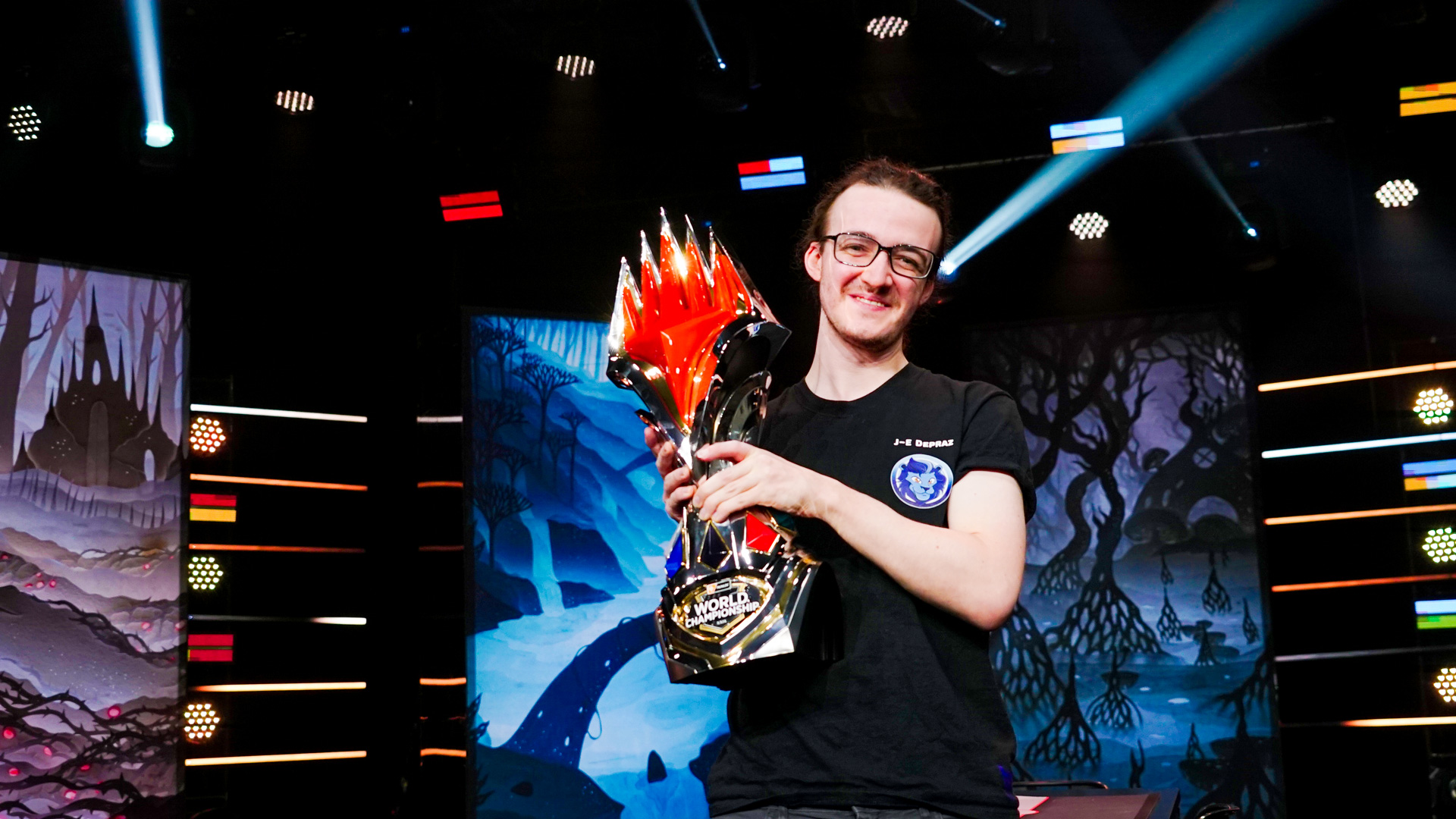
That's what "technical play" means when it comes to Depraz, who has been regularly cited by his peers as the top technical player on the planet at various times. But when it comes to digging into what that actually means—beyond making JED the default answer to "who do you think will win this tournament?" for a long stretch of time—it's important to understand how the 32-year-old French phenom sees a match of Magic at its most fundamental level.
"As a competitor, it's always mostly been between me and myself rather than about besting others," he explained. "I am competitive; I will obviously always enjoy seeing my name at the top of the standings. But for a long while, my main drive has been to prove to myself that I can be good at something, that there is some space that I can thrive in."
You're playing
The answer you're shouting at your screen is, of course, "it depends." But what it depends on changes from game to game, from matchup to matchup and from tournament to tournament. How well a player navigates that choice moment to moment separates those deemed great "technical players" from the rest.
"There's a difference between strategic play and technical play," explained longtime Pro Tour competitor and Hall of Fame voter Anthony Lee. "Strategic play is the idea of how to approach the game and what to do, and technical play is how you do it, such as sequencing your plays correctly to gain the most information."
Depraz believes that asking the right questions is one the biggest keys to gaining an edge in matches. Going back to the example, the question of "should I
"The output to that question is not as easy as 'which of these lines does more damage?'" Lee explained. "What I remember from watching JED play is that sometimes you have to decide which decision you'll have to make is most contingent on gaining information. You're looking at the range of outcomes—how different will my Thoughtseizes be on turn one versus turn two or three, is the decision I'll make with the surveil going to change if I gain new information by holding it for a turn or two? Good technical players are good at figuring that out, and many players don't even realize it's important."
Depraz sees the concept of "technical play" extending as far as fine-tuning decks and sideboard plans. He believes his career really took off around a decade ago when open decklists became the norm in high-level tournaments, allowing him to tune his decklist in between games down to the final line. Yes, it's all math in the end—but the best math rhymes.
"A lot of Magic players have a deep connection to maths, and I do, too—my high school diploma was scientific—but I feel like, as in many other aspects of life, the mathematical approach tends to take too much space and/or be framed in terms that don't faithfully describe the process," Depraz explained. "I rarely find myself 'calculating' during a game. When I do, it means a choice is simple enough to be reduced to numbers I can effectively crunch. Usually, that comes up very early on, for mulligan decisions, or in especially clean end-games where my opponent is topdecking. Most of the time, though, I have to take a more qualitative approach."

Among those considerations:
- What information can be gleaned from what the opponent is doing?
- What are all the options available?
- What is the likelihood of Y happening if I do X?
- If it does happen, how good or bad would that be?
"Each of these steps is very important and too often, when I see someone make a mistake, it's the result of having skipped one or several of them: ignoring the information their opponent has given them; missing an option—usually, the option to do nothing—because they rush to a set of predetermined plays; failing to account for the fact that some consequences are much more dire than others because they're too focused on trying to calculate which scenario is more likely. Overall, question three gets a lot more brain power than the others despite it being the least interesting … and the one we, humans, are the least capable of answering confidently. A Magic-playing engine would probably translate each question into numbers and calculate, but we are not engines and we should try to play to our strengths.
"I understand Magic theory well enough, but I'm just far less interested in deck building and metagaming. On the other hand, when you have a deep perspective on what happens in each game, you don't need to play many games to suggest meaningful adjustments to a list; you can guess how things are going to change if a new element gets added."
That's a recurring theme with our trio of Hall of Fame inductees this year: one of their biggest strengths is in how they think about the game. Whether it's Ken Yukuhiro bringing a surprise brew not just because it's a surprise brew that he likes but because he believes surprising his opponents gives him the best chance of success or Depraz nailing the trajectory of a match in progress from as early as the first
It's also what earns you a remarkable reputation among your peers.
"It's all subjective; when one of us says someone is the best, it's because we've watched them play and talked to them about their play," Lee elaborated. "With JED, if you ask him about a decision he made in the game, he can explain very lucidly exactly why he did what he did. When you start out and see that, it's very clear that they've thought about every little piece of their play, and they're seeing all this stuff that I'm not."
That insight is invaluable, and not just to Depraz in the moment of his match.
"He's not the one who brings the ideas, but he's excellent at fleshing them out or shooting them down in fast-paced testing houses," shared Alexey Paulot, one of Depraz's Pro Tour testing teammates for the last half-decade. "Because he's such a thought-out player, he picks up decks very quickly. He doesn't need much practice to learn a deck, so the team can churn through decks fast.
"It's great having him on the team, but sometimes it's a bit annoying, too, because he'll outplay anyone even when his deck is worse! Several times we met in the finals of our testing-team drafts. I clearly had the better deck, but he beat me anyway, not because I got unlucky but because he totally outplayed me. Jean-Emmanuel is clearly one of the best technical players in Magic history, and clearly the best I've ever played against. He really strives for perfection in his plays and in the way he carries himself at the table: every play is thought out and has a reason."
Professional Magic is a scene full of humans using calculators to determine the best plays online and human calculators running complex math in moments at the feature match table. But for all its complexity and calculations, the math will never tell the whole story of what it means to be a great Magic player, or even the best "technical Magic player," in the same way that no machine can produce genuine beauty. To play so well, so consistently, evokes—as all great poetry does—a sense of romance for what makes competitive Magic beautiful to Depraz.
"Honestly, it means the world to me to be described like this," he opened up. "You want people to think you're good at what you value the most yourself, and I've always been amazed at people who can win with ham sandwiches. For me to play at my highest level, the most important thing is motivation, which is derived from a good life balance. That's how I come to find the zone."
MagicCon: Atlanta is a month away, along with Depraz's induction into the Magic Pro Tour Hall of Fame alongside Ken Yukuhiro and Javier Dominguez at Magic World Championship 32.
